What a Raw Land Deal in Bentonville Actually Costs to Close and Hold
Bentonville raw land pricing, due diligence, entitlement timelines and carry costs broken down so investors can underwrite a parcel before writing an offer.

Most buyers walk a Bentonville tract, run a quick dollars-per-acre comp against the listing, and talk themselves into the deal before lunch. The problem is that the per-acre number is the smallest line on the real spreadsheet. Between an accepted letter of intent and a shovel in the ground sit survey work, geotech borings, title, entitlement, utility extensions, loan carry, and property tax that keeps grinding whether the parcel does anything or not.
This is a line-by-line pass at what a raw land deal in Bentonville actually costs to close and hold, with current numbers for Benton County and the City of Bentonville, and the hurdle rate the dirt has to clear before the deal is worth doing.
The Bentonville Per-Acre Comp Is Not a Single Number
Regional averages are useless at the parcel level. Land around Fayetteville and Bentonville averages roughly $8,500 per acre on a broad statewide read, but that figure blends recreational timber in rural Benton County with infill tracts half a mile from the Walmart home office. Both are "Northwest Arkansas." Only one of them pencils as a development play.
Pull the active inventory instead. Undeveloped parcels across Benton County are listing at an average of roughly $111,640 per acre, and inside the Bentonville city limits the average listing price per acre runs materially higher once you weight for small infill lots near downtown and the SW Bentonville growth corridor. A quarter-acre commercial pad near 8th Street can be priced at a per-acre figure that would buy a 20-acre tract near Pea Ridge outright. The comp set that matters is the five or six parcels inside a one-mile radius with similar frontage, utility access, and zoning posture, not the county median.
Submarket matters as much as acreage:
- Downtown and Market District: trophy small lots, driven by Walmart campus proximity and Crystal Bridges spillover. Price per acre is almost irrelevant; what you are buying is a build-to-suit site.
- SW Bentonville / Centerton line: the volume submarket for subdivision and multi-family land. This is where per-acre comps have the most signal.
- East Bentonville toward Rogers: commercial frontage along 102 and SE Walton. Priced on traffic count, not acreage.
- Unincorporated Benton County edges: cheapest on paper, but entitlement risk is different because Benton County does not have zoning in unincorporated areas. Subdivision regs still apply, and annexation economics shift the moment the city line moves.
Any serious underwrite starts with a submarket-specific pull from raw land and lots inventory and a hard look at what has actually closed, not what is listed.
Survey, Geotech and Title Are the First Real Checks You Write
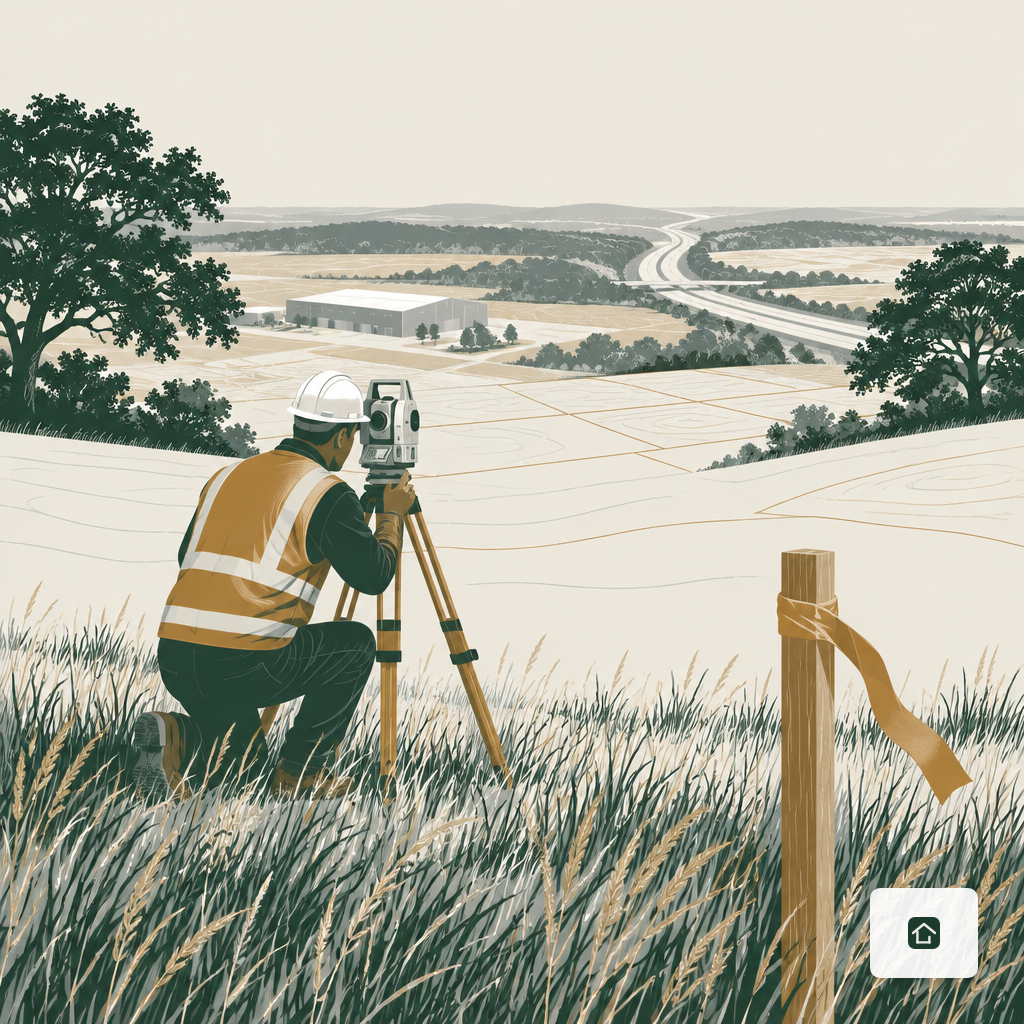
Due diligence costs land in the $8,000 to $25,000 range on a typical five-to-twenty-acre Bentonville tract, before a single entitlement application gets filed.
An ALTA/NSPS survey in Arkansas runs $2,400 to $6,400 for a standard commercial parcel, with Table A items adding $100 to $500 apiece. Any lender making a commercial land loan will require it. On wooded or topographically ugly Ozark terrain, surveyors add 20 to 50 percent, and larger acreage gets quoted case by case. Budget the top of the range on anything over ten acres with tree cover.
A Phase I environmental runs $2,500 to $4,500 in NWA on a clean parcel; chicken-house heritage, old service stations, or former ag spraying raise the odds of a Phase II that can add $8,000 to $25,000. Geotech borings for a buildable site typically run $3,500 to $8,000 depending on the number of borings the structural engineer calls for. Karst and shallow bedrock are real risks on the plateau and change your foundation cost dramatically if you find them after closing instead of before.
Title insurance on the land itself follows the Arkansas rate schedule of $2.00 per thousand for coverage from $100,000 up to $500,000, and $1.75 per thousand from $500,000 up to $10 million. On a $1.2 million land purchase, that is roughly $2,025 in owner's premium, plus a lender's policy if you are financing.
Entitlement Is Where the Timeline Gets Expensive
Hard dollars for entitlement in Bentonville are modest by coastal standards. The problem is time, not fees.
Inside Bentonville city limits, a rezone runs a minimum of five to six weeks from a complete submittal through Planning Commission to City Council action, assuming no neighborhood opposition and no sent-back-for-redesign cycles. In practice, assume three to four months with the mailing packet, 200-foot notification radius, published notice in the Democrat-Gazette, and the posted public hearing sign. Variance, conditional use, and preliminary plat each run on their own clock. A greenfield subdivision from LOI to a recorded final plat is a 9-to-14-month exercise if nothing goes sideways.
Impact fees are the other variable. Bentonville's current parks, library, police and fire impact fee schedule was adopted November 14, 2023, and the council voted in February to engage TischlerBise for an updated study not to exceed $74,110. Translation: the fee schedule you underwrite to this quarter may not be the one you pay when permits pull. Build a 15 to 25 percent contingency into the per-door entitlement line until the new schedule lands.
The Benton County side is simpler and riskier in different ways. The county enforces subdivision regulations and reviews commercial and industrial development, but it does not zone. A buyer gets flexibility; a lender and future buyer get uncertainty about neighbor use. Pricing the exit assumes something about who shows up next door.
Utility Extensions Are the Silent Deal Killer
A tract that is 1,800 feet from the nearest 8-inch water main and 2,400 feet from a usable sanitary sewer tie-in is not the same asset as the one across the street with stubs at the property line, even if the per-acre list price is identical.
Industry pricing for municipal water-line extension runs $25 to $200 per linear foot, with sewer at $50 to $200 per linear foot. Rock, creek crossings, and bores under existing roads push the top of the range. On a 1,500-foot extension of 8-inch sewer plus 8-inch water, a reasonable budget is $350,000 to $600,000 before meters, taps, and inspection fees — enough to erase the margin on a 10-acre townhome deal. Electric extension runs $15 to $80 per foot of trench on standard rural overhead or underground primary.
Get written availability letters and extension cost estimates from Bentonville water utilities, Black Hills Energy, and Carroll Electric or Ozarks Electric before you remove the inspection contingency. For context on how utility reach and submarket demographics interact, the data in the NWA commercial real estate statistics post is a useful cross-check on where new rooftops are actually landing.
Holding Costs Grind Whether the Deal Moves or Not
Raw land does not throw cash. Everything on the carrying side is a drag, and most of it is non-negotiable.
Property tax. Benton County uses an average total millage of 55.04 for 2026 collections, with district rates ranging from 42.86 to 62.23 mills, and Arkansas assesses real property at 20 percent of market value. On a $1.2 million tract inside the City of Bentonville at the county average, expect roughly $13,200 a year in property tax, with the exact bill depending on school district and city overlays. Larger tracts occasionally qualify for an agricultural use valuation that drops the assessed value sharply, but reclassification happens the moment the land stops being used that way. Underwrite the market-value tax; treat any ag discount as temporary. Millage variation across NWA is wider than most out-of-state buyers expect.
Debt service. FDIC guidelines set minimum down payments of 35 percent for raw land, 25 percent for unimproved land, and 15 percent for improved land. In practice, raw land loans commonly require 30 to 50 percent down and carry higher interest rates and shorter terms than loans on improved land. On a $1.2 million purchase with 40 percent down and a 10 percent rate on a 5-year interest-only land note, that is $72,000 per year in interest carry on top of taxes, insurance, mowing, and liability coverage.
Insurance, mowing, fencing, mineral or title cleanup. Call it $3,000 to $8,000 a year on an average tract. More if there is a creek, FEMA floodplain, or any structure on site.
The Hurdle Rate the Land Has to Clear
Raw land has to appreciate fast enough to beat the all-in carry plus a return on the capital stuck in it. The math is unforgiving.
On the $1.2 million example tract, annual carry runs roughly $88,000 — about $13,200 in property tax, $72,000 in interest on a 40 percent-down land note, and $3,000 in soft costs. That is 7.3 percent of purchase price per year, before any required return on equity. Add a 10 percent hurdle on the $480,000 cash in, and the parcel has to appreciate roughly 11 to 12 percent a year just to break even on a three-year hold. In an NWA submarket averaging 6 to 9 percent land appreciation, the thesis has to be entitlement, assemblage, or a specific end user, not raw price inflation.
That is why the honest raw land plays in Bentonville are usually one of three things: a rezone that moves the parcel from AG or R-1 to a higher-density residential or commercial category; an assemblage that creates a developable site larger than the sum of its parts; or a land bank held against a known corporate expansion. For buyers thinking about the build-side math on the other end, the build-versus-buy multifamily analysis is a useful companion read.
What a Real Underwrite Looks Like at Close
Before signing a contract on a Bentonville tract, the numbers should fit on one page:
- Verified submarket comps from closed sales within 12 months, not active listings
- Written utility availability and extension estimates from each provider
- A survey, Phase I and geotech scope quoted and scheduled
- An entitlement path with a realistic calendar through Planning Commission and City Council
- A current property tax projection using the city-overlay millage, not the ag rate
- A debt structure that accounts for the 30 to 50 percent land-loan down payment
- An exit assumption that names the buyer, the product, and the price per unit or per foot
Everything that gets skipped at the LOI stage gets paid for later, usually with interest. The parcels that pencil in Bentonville right now are the ones where the buyer has already priced the entitlement calendar and the utility extension before anyone talks about granite countertops.
If a specific Bentonville tract is on the desk and the question is whether to pull the trigger, start with the commercial brokerage underwrite before the appraisal. The appraisal confirms what the market says. The underwrite tells you whether the deal pays you back.
Christine M writes about Northwest Arkansas real estate and investment for Estate.co.
More from Christine M


Thinking about investing in Northwest Arkansas?
Talk through your goals with an operator who has closed in this market for two decades.